Isabelle Ning: EGMO 2026 Report
This was what I had been looking forward to since the moment the last EGMO ended. I am beyond grateful to be representing New Zealand again at the 15th EGMO, or the 2nd one that New Zealand has ever participated in. Being in the team last year, I was slightly more prepared about what to expect, and what to work on in the last few weeks before departure (yes - I had still crammed most of the preparation in the week prior, and left packing on the day of our flight. I will learn some day, trust!)
Pre-EGMO thoughts and yap:
Starting from EGMO 2025, I have been going through an identity crisis. I used to think of myself as a combi main, occasionally solving some pretty tricky problems, but since Turbo’s appearance on Q5 last year, somehow I had managed to solve fewer combinatorics problems than all the other areas. I comfort myself by thinking that this is because I’ve gotten better at the other areas, but it is still unsettling to consider, so I just try not to think about which areas I prefer anymore. From what we’ve all learnt from last year, I think that this is a good strategy!
Throughout the year, I have also received a lot of useful advice that I will hopefully remember for EGMO. Below are just a few:
“First you noooootice, then you solve” - We have learnt that nooooooticing is particularly useful in solving a problem.
“All triangles are equilateral” - This is especially useful for all geometry problems if you know that all angles are 60 degrees. Unfortunately, the proof of this is a victim of diagram dependence, and therefore it is a fakesolve.
“Do maths like you hate the trees” - This advice was actually quite helpful for me, as I have always struggled to dump all my ideas onto pieces of paper. Instead, I prefer gazing off into the distance and attempting headsolving (this has a 10% success rate). Honestly should’ve learnt from the lost A1 mark last year.
Mini NZ training (3rd and 4th of April):
This year, we were fortunate enough to have the opportunity to lock in together before departing, including sitting a mock together! This means losing my real name earlier, and being promoted to NZL2 before even leaving New Zealand. We request to work on some algebra, as non-inequality and non-functional equation resources are quite scarce. The mock goes surprisingly well for me, getting a 7/7/4, and I seem to have learned not to spend 3 hours on the first question. I think part of the reason my scores are so inflated might have something to do with us rigging the mark scheme in our favour. Anyhow, I’m extremely proud of solving question 2, an algebra-flavoured number theory, in which my solution apparently proved that the harmonic series diverges, with me barely knowing what any of those words mean!? Additionally, all of my solutions, plus rough work, only added to a mere 11 pages of paper, which gives me hope that maybe we could love the trees after all!
After a tiring day of maths, all of us get matching sheep keychains (thank you, Mrs Kim!), which highlights the kiwi (or sheep) spirit was STRONG!
Le voyage (5th and 6th of April)
I think this was quite an uneventful trip - It just consisted of games of beat the landlord, sleeping, window shopping, attempted mathsing (mainly initiated by Bella), and more sleeping. By the end of this trip, I couldn’t really believe that I was finally in France, I could put my duolingo/school French to some use! Although French fries are not from France, Sophie insists on eating fries throughout the trip (starting from Auckland), as potatoes are her favourite food, so we enjoy many different types of fries in Auckland, Amsterdam, and Bordeaux.

Photo: Attempted locking in on the plane
Unjetlagging time (7th and 8th of April)
One of the first activities we do in Bordeaux is a pastry tour, and to sum it up, we tried many different types of bread, and also walked a lot to learn about the city’s history. An interesting fact that I learnt is that in France, there is a price ceiling of 2 euros for a baguette! In the afternoon, we meet up with the Australians to go on a tram tour and play avalon, as well as having dinner together. I get to practice some of my French, which was really exciting, and NZL also becomes target practice for the Aussie’s koalaing skills.
The next day, we wake up bright and early to do another mock in order to get used to the environment and further prepare ourselves for the real exam. The previous day, Bella had wanted algebra, combi, and geometry in that order, and to her delight (and my disappointment), that is exactly what we got. After realising the first question was an inequality, and the second one was a graph theory, I attempted the third question, only to realise I couldn’t draw a good diagram. This was pretty much the same story for the rest of the exam, and I end up with a sad 2/1/0 (after much rigging of the markscheme). Our combined team total adds up to a tremendous 7 points, and Bella tries to cheer us up by stating, “At least it can’t get worse in the actual exam!” - Will we jinx it again?
In the afternoon, after marking each other’s papers, we visit the illusion museum, which plays with our brains even more, and we have dinner with the Australians again, where we try snails. They taste surprisingly good, and we pray that this will make us have Turbo powers.
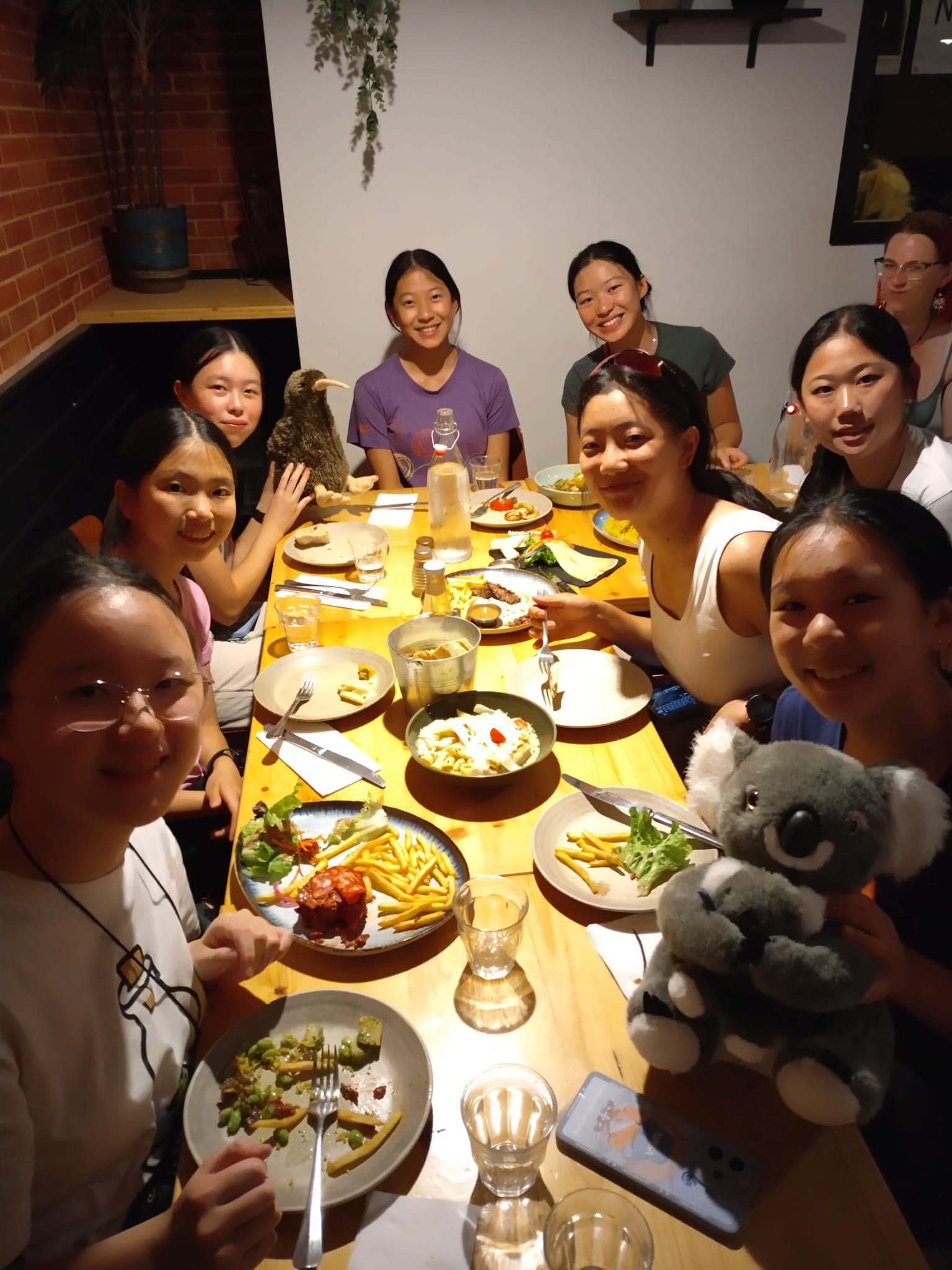
Photo: Kauchy the Kiwi gets Koalaed
Arrival + Opening ceremony (9th and 10th of April)
We arrive nice and early for arrival day - a day where we could socialise and meet all the other teams, or talk to people whom we have only talked to before on Discord. We receive some super cool EGMO merch, including the game ‘Set’, which will hopefully improve our nooooticing skills.
The next day, we have a treasure hunt, which I had been looking forward to, as we didn’t get to experience it last year. To sum it up, it was a bunch of us walking around the city, doing more walking than we probably had done for the past month combined, and realising that we can’t do basic arithmetic.
The opening ceremony was where we could socialise with more teams, showcase our New Zealand spirit, and witness some magic happening, including turning invisible and mind-reading through water.
Reminder that hydration is important during the exam!

Photo: Countries at the opening ceremony © Gautier DUFAU
Exams (11th and 12th of April)
This year’s exam was quite different to last year’s exam - it was held across several classrooms, which I thought was quite convenient, but unfortunately, it also felt more like a mock rather than our real exam.
Day 1: Before I knew it, the exam already started, quite literally. The pre-exam countdown turned into ‘time left’, but we were not told to open our exam, so we had one minute where none of us was doing anything. After I opened my paper, my first thought was, omg, no geometry, followed by “Why is there a functional equation?” For some context, I had said a few days ago that functional equations were soooo out of fashion, so there was no way we were going to get one. Turns out that we are very good at cursing ourselves (common motif throughout EGMO)! After I calmed down a bit, I solved Q1 quite quickly after trying a few constructions, but the write-up took a bit longer, a bit past 1.5 hours. When I saw the question 1 combi, I was a bit worried as I usually struggle with writing up rigorous arguments for combinatorics problems. However, I was pretty sure that my argument was quite sound, so I moved on. With high hopes, I decided to try questions 2 and 3, which were interesting, but I didn’t make any significant progress. I managed to solve 2a by simply considering n!, but 2b and question 3 were quite challenging. I wanted to scrape some partials in question 3 by conjecturing the answer and proving injectivity or f(x)=0 (this was a fakesolve as I had fallen into the somewhere vs everywhere trap), but apparently, this simple-looking question had so many steps in the solution that the progress I made counted as insignificant. Nonetheless, I am quite proud that I tried to prove injectivity for the first time, and I’m quite happy with my day 1 performance (I got 7/2/0). On a side note, I think my combinatorics powers are coming back - I solved an actual combi problem in who knows how long!
To take our minds off today’s and tomorrow’s exams, we sign up for a pottery-making class to squish our stress away. I think this turned into more of just an excuse to laugh at each other’s art skills, as our ‘artworks’ resembled potatoes and Easter Island statues more than actual humans.
Day 2: After Bella had cursed us for a Q1/4 algebra on the mock, we were sure that this curse would not continue. We were wrong. As soon as I opened the paper, I saw a Q4 algebra, followed by a chunk of text for the geometry Q5 glaring at me. With the mock still fresh in my mind, I tried to convince myself that this Q4 algebra was solvable, and it was worth spending more time on this problem than Q5. After fully understanding the question and proving a lemma that I didn’t see as useful, my next idea was to use strong induction, which I also had not done before this exam. Trust, it looked very inductable!! Spoiler alert: this was not a good idea. My “useless lemma” was a weaker case of a useful lemma, which was what led me to get one point on that question. Anyways, about half an hour into question 4, I thought I had solved it using strong induction! This made me really hopeful as I had a bit less than 4 hours to attempt a Q5 geo, which seemed doable. Then, upon writing up my Q4 solution, I realised I fakesolved two of the four cases due to basic algebra mistakes. Seems fixable, right? This was why I chose to dedicate a large portion of my remaining time to this problem. However, this “fix” was very complicated, and even after fakesolving a few more times, I ultimately still couldn’t solve the problem. It was only after the exam that we were told that there was no induction solution - no wonder I couldn’t solve it that way. While being stressed about Q4, I still attempted Q5 and 6 as we were told to, but I got as far as drawing a diagram, constructing some useful points, and making observations about them. I tried to draw an accurate diagram, which turned out to be crucial in the solution of this problem (realising 3 points were collinear), but I didn’t have much time to do so, as I returned to sulking over Q4. I ended up with a 1/0/0 for my efforts. Although this wasn’t the best day for me, I think there is a lot to be learned. Firstly, write down all observations because for question 4, if I wrote down that my “induction” worked for all powers of two, that would’ve gained me another mark, and since we don’t know what earns us partials, we should just write everything down! Secondly, it is really important to take a step back in some cases. After fakesolving many times, I probably should’ve tried a different approach, even though this approach seemed so close. And take a TTB (tactical toilet break) if needed! Finally, another thing that probably would’ve been helpful was to try question 5 for longer, to maybe scrape some more partials.
With the most stressful part of the trip out of the way, we enjoy a magic workshop by Louis, the same hilarious magician who had performed in our opening ceremony. Although he didn’t teach us how to turn invisible, we learned many cool card tricks that I will definitely perform on some people (whether or not successfully is another question). In the evening, we enjoy a fancy Jane Street dinner, where more socialising took place. Apparently, the maths was not enough for our brains, so we spend a large portion of our time there solving puzzles and playing chess.

Photo: NZL and AUS before exam day 2, oblivious to what is ahead of us © Gautier DUFAU
Excursions (13th and 14th of April)
On the days following the exams, we travelled a bit further to explore more of France, to Saint Emilion and the Dunes of Pilat. We explored a historical city, as well as the vineyards, which were also very interesting, the only downside being that it required a lot of walking too. That evening, the live scoreboard is released, and I find out that I got 10 marks, right at the border of HM and bronze. The next morning, I wake up to find that the cutoff for bronze was indeed 11 points, which was a bit disappointing at first, but after all these excursions and experiences, I’ve realised that the maths in EGMO is only a small part of it. And with that, we go to our Dunes of Pilat excursion, where we climb some dunes, then run/roll/fall off them, and I get a crazy amount of sand in my shoes. After the closing ceremony and the afterparty, EGMO came to a close.

Photo: NZL at the closing ceremony
Trip back (15th, 16th, and 17th)
Ironically, the trip back was way more eventful than the trip there, perhaps as a result of Brena’s “You can do whatever you want after the exams”. We left Bordeaux with 7 people and 7 pieces of luggage, and we arrived back in Auckland with 4 people and 3 pieces of luggage, and we ‘lost’ a non-zero number of people at every airport. Let’s just say, remember to put all your power banks (especially if given by the organiser) in your carry-on luggage, and always keep your passport with you!
Questions
How has attending this event demonstrated greater knowledge of available career paths in science and technology?
Through the sponsors and the guest speakers, I was exposed to various career paths that I had never known about before going to EGMO, and I gained an inside perspective on what it was like to work in them.
How has attending this event enthused or inspired you to pursue science and technology careers? Has attending this event changed how you feel about science or technology?
I’ve always wanted to pursue a career in science and technology. However, through these talks, I’ve now realised that there are so many more options within this path, so I’m now more inspired to be open about what I undertake within this path (eg. research, data analysis, etc.)
How has attending this event and participating with like-minded students been of benefit to you?
It was amazing to see the way that so many like-minded girls from around the world could connect so easily through a common passion for mathematics, and it allowed me to find a friendly community. Because of this, it was easier to make friends, practice foreign languages, and learn more maths just through conversations with them!
Now that you have had time to reflect about your experience, what have you learnt about yourself?
I went into the competition just wanting to have fun, but throughout this experience, I realised just how much maths matters to me, which is something new that I learnt about myself. I’ve always liked it a lot, but by immersing myself in other girls who like maths, I’ve discovered that it’s a big part of my life that I always want to enjoy.
What did you enjoy about your experience?
The entire experience was enjoyable for me - tackling challenging maths problems, meeting new friends, exploring a new country, and everything in between.
Merci beaucoup!
Firstly, a big thanks to the sponsors of EGMO, especially Jane Street, for sponsoring events like these, making them so much more accessible for everyone. Additionally, thank you so much to my parents and everyone else who has supported me throughout my journey, allowing me to discover my passion for mathematics. Furthermore, a big shout-out to our guide Duncan for all the laughs we shared, the French you taught us, and, of course, for showing us the way around Bordeaux. Also, a special mention to the Australians for making this experience so much more enjoyable! Moreover, thank you so much to Mrs Kim for organising this trip, and Josie and Brena for taking care of us and fighting for every mark we deserve. And last but not least, thank you to my teammates, Bella, Jackie, and Sophie, for giving me such an enjoyable time in EGMO, and also for tolerating each other. If you have read this far into my report, I think it is worth giving you a taste of how I bother my teammates every day - you, the reader, have lost the game.